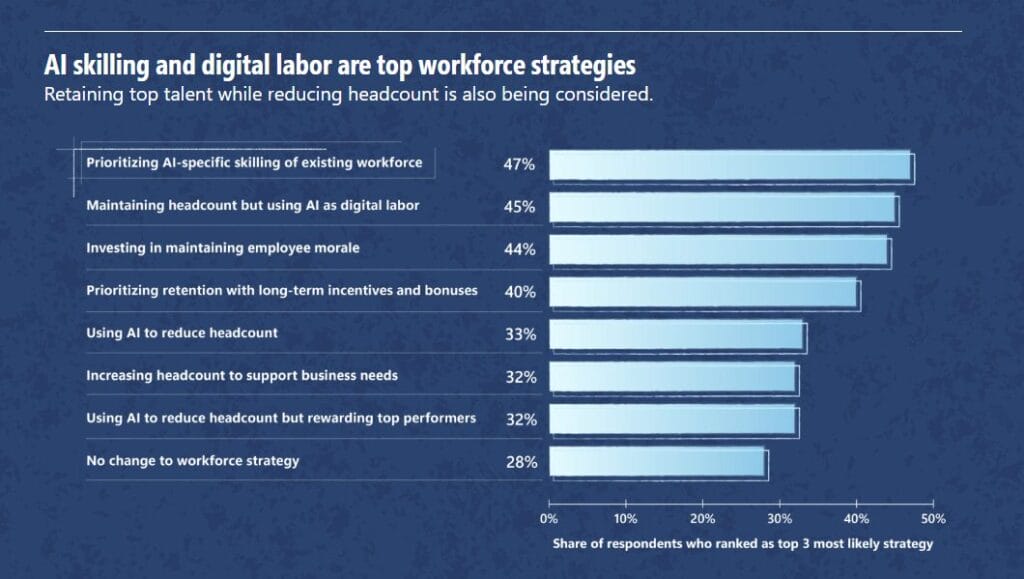
According to Microsoft’s latest research, the “Frontier Firm” has arrived. These organisations aren’t just using AI; they are rebuilding their entire business model around the concept of intelligence on tap. The transition from AI as a chat bot or “search tool” – to AI as “digital labour” is the defining shift. Is your business leading the charge, or is it tethered to an old fashioned blueprint?
How to Use This Audit
The following questions are designed to help you look beyond the “hype” of AI and evaluate the structural reality of your business. Becoming a Frontier Firm isn’t about how many licenses you’ve bought (anybody can buy Copilot); it’s about how deeply you’ve integrated digital labour into your core operations. As you read through each section, you need to be honest about your current workflows. This isn’t just a checklist – it’s designed to be a roadmap to identify the specific “capacity gaps”. These gaps are where your business can gain the most ground with AI.
The questions are split into the following sections:
- Part 1: The Frontier Foundation
- Part 2: The ‘Agent Boss’ Mindset
- Part 3: Operational Agility
- Where does your firm stand?
- Tools that can help
- Why Managed IT is the Missing Piece
Part 1: The Frontier Foundation
You can buy intelligence on tap
For decades, intelligence was one of the most valuable – and limited – assets in business, bound by human time, energy, and cost. That’s changing. Intelligence is becoming an essential durable good: abundant, affordable, and available on demand.
Part 2: The ‘Agent Boss’ Mindset
Part 3: Operational Agility
Where does your firm stand?
Tools that can help
- Microsoft Copilot Studio The primary workspace for building, managing, and publishing your own custom AI agents. It allows you to create autonomous “digital colleagues” that can plan, learn, and execute tasks across your business data.
- Microsoft 365 Copilot Agent Builder A “lite” experience within M365 that allows any employee to become an Agent Boss. Users can quickly create declarative agents grounded in specific SharePoint files or Teams chats without needing deep technical expertise.
- Azure AI Foundry (formerly AI Studio) The “factory” for professional developers to build more complex, enterprise-grade multi-agent systems. It provides the hosting, security, and governance needed to run sophisticated AI operations at scale.
- Microsoft Graph & Copilot Connectors The “connective tissue” that gives your agents access to your entire business context. Use these to bridge the gap between Microsoft 365 and external data sources like Salesforce, ServiceNow, or Google Drive.
- Azure AI Agent Service A managed service for hosting and orchestrating autonomous agents. It manages “threads” and “runs,” allowing your agents to maintain long-term context during complex, multi-step projects.
Why Managed IT is the Missing Piece
While these tools are powerful, they require a secure and governed environment to function. Our Managed IT and ITaaS offerings ensure that:
- Your data is “AI-ready”: We help you clean and structure your data so your agents don’t hallucinate or leak sensitive information.
- Governance is automated: We manage the Copilot Control System, ensuring the right agents are used by the right people at the right cost.
- Scale is seamless: As you move from Phase 1 (Assistants) to Phase 3 (Agent-Operated), we provide the infrastructure that scales with your growth.
Don’t let technical complexity block your path to the Frontier. Build your AI-first infrastructure with MTG.
Read more
Want to dive deeper into the data and the future of digital labour?
- Microsoft Work Trend Index 2025: The Year the Frontier Firm Is Born Explore the full definitive study on how “Intelligence on Tap” is rewiring global business. Learn why 2025 is the turning point for autonomous agents and the rise of the human-led, AI-operated organisation.
- Stanford HAI | 2025 AI Index Report For a broader look at the global state of AI, Stanford University’s 2025 Index provides an unbiased, data-driven analysis of AI’s impact on the economy, public opinion, and the technical benchmarks that define the current “Frontier” of machine capability.